I’m a bit tapped-out of late when it comes to writing. I’ll need to fill the well again at some point this week.
That said, I want to post a bit more about two of my favourite slasher movies I recently re-watched.
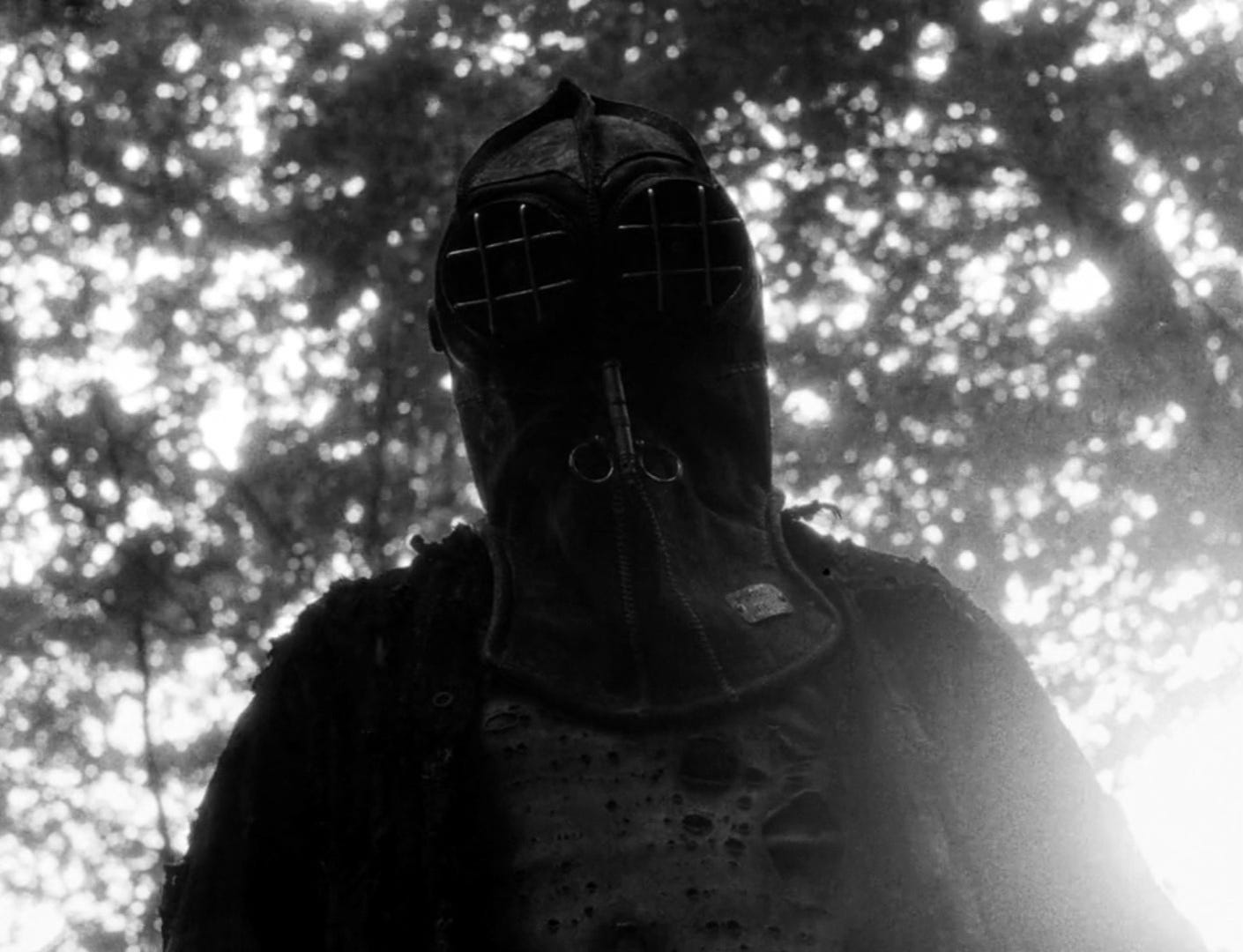
First, a Canadian movie I adore IN A VIOLENT NATURE. I touched on it in THIS POST.
Despite the film’s deconstructive desolation, Nash finds equal beauty in the bucolic forest Johnny calls home. Once the site of a company mining town whose workers led to Johnny’s demise (and, grimly, vice versa), Johnny’s woods are lovely, dark, and deep, thrumming with cicadas and lush greenery. The forest is also rampant with death—not just in the remains of the watchtower that serves as Johnny’s resting place, but also in the decaying animals caught in forgotten bear traps. Johnny, a revenant killer caught between life and death who only arises when provoked, has a decomposing form that feels as natural as it is supernatural. He is as much a part of the forest’s natural order as his fellow creatures.
In contrast, the loosely antagonistic forces against Johnny—these campers, a courageous park ranger, and even a belligerent country yokel—feel as invasive and benignly menacing as the bear traps littering the forest. Sure, the evilest act these teens commit is to steal the locket which awakens Johnny and his bloodthirsty curse; however, it’s an act the film puts on par with the placement of these instruments of death, one whose actions similarly lead to ironically grisly fates. This meticulous, meditative reversal subverts the expectations of a horror movie, especially a slasher film. It not only orients our sympathies towards the slasher at its core but also provokes us to reconsider the circumstantial victimhood of those who fall prey to the central villain.
The overall effect lands somewhere on a spectrum between the lingering beauty of Terrence Malick and the dispassionate terror of Michael Haneke, with the enchanting environmental beauty both at odds and wholly congruent with the gut-churning violence taking place within it. In one of the film’s most stunning sequences, the camera barely moves as it captures Johnny’s descent into a lake towards a swimming victim, who just as suddenly disappears–save for a brief, silenced scream–beneath the water. It’s a sequence that would normally be milked for all the Spielbergian tension it can muster, yet Nash’s deliberate lack of action beautifully contrasts the beauty of the lake’s stillness with the cruelty occurring beneath its depths, marking our complicity in bearing witness to every inseparable, excruciating moment.